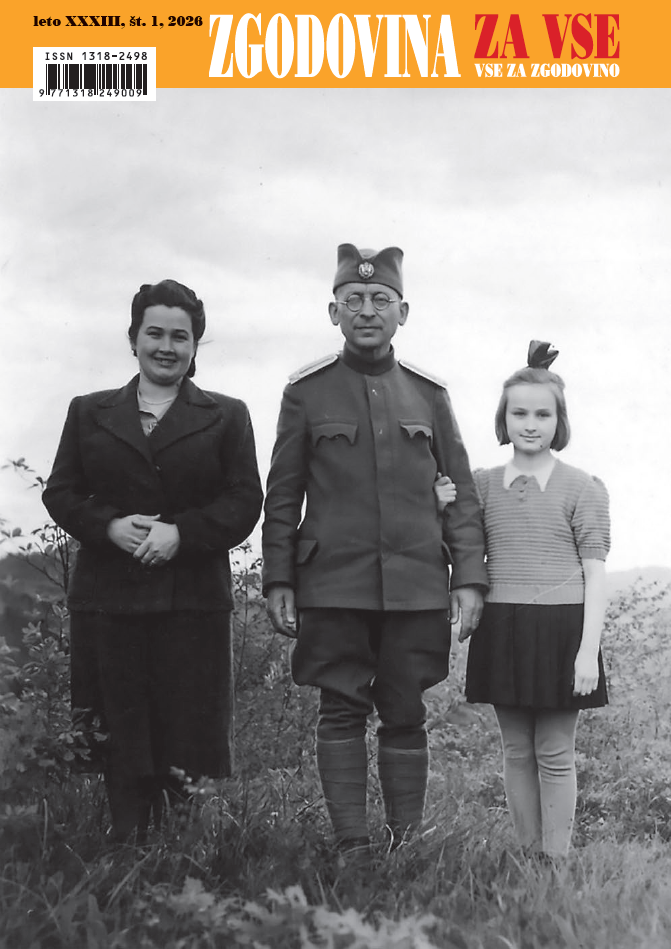
Dušan Špindler – Kovač (1912–2003)
Teacher and Central Organizer of the Resistance Movement in Maribor
Keywords:
Maribor, resistance movement 1943-1945, Dušan Špindler, Informbiro, execution of partisan recruits on Pohorje in 1944Abstract
Through a biographical study of Dušan Špindler (1912– 2003), the author examines the resistance movement in Maribor, whose main organizer from autumn 1943 to spring 1944 was this schoolteacher. A committed communist, Špindler taught at several elementary schools during the 1930s. After the Nazi occupation and his return from the Mauthausen concentration camp, he was tasked by the Central Committee of the Communist Party of Slovenia for northeastern Slovenia with building the backbone of the Maribor resistance movement, with the assistance of fellow teachers. During the Informbiro trials of 1949–1950, he was sentenced to a long term of imprisonment with forced labour on charges of collaboration with the Gestapo. However, his conviction was most closely connected to the tragic events on Pohorje in January 1944, when a group of new recruits from the Slovenske Gorice region were tortured and executed within a partisan unit on suspicion of sympathizing with the Blue Guard movement.
References
Arhivski viri
Arhiv Muzeja narodne osvoboditve Maribor (AMNOM)
58/I, osebna mapa Maksa Gašpariča.
Arhiv Republike Slovenije (SI AS)
SI AS 1931, Republiški sekretariat za notranje zadeve SRS, t. e. 537–539, proces proti Kurtu Stageju in ostalim.
SI AS 1237, Vrhovno sodišče SRS, Ktr 746/77 – obnove, D. Špindler in ostali.
SI AS 1589/IV, CK ZKS, izključeni/črtani člani KPS/ZKS, t. e. 3597, mapi Dušana Špindlerja in Gizele Špindler.
Pokrajinski arhiv Maribor (PAM)
fond: Maks Gašparič, Spomini Dušana Špindlerja.
Zgodovinski arhiv Ljubljana (ZAL)
fond: Okrožno sodišče Ljubljana, t. e. 549–551, spis K 312/50, I.–III. del, Dušan Špindler in ostali.
Tiskani viri
Ostrovška, Milica. Kljub vsemu odpor, 1.–3. knjiga. Maribor: Založba Obzorja 1963–68.
Zalaznik, Franc. Dolga in težka pot 1941–1945. Maribor: Založba Obzorja, 1963.
Časopisje
Delo, 1972.
Jutro, 1937.
Ljudska pravica, 1944.
TV-15: naš tovariš, 1984.
Večer, 1981, 2023.
Članki in monografije
Čepič, Zdenko. »Mara Čepič«. V: Mariborske osebnosti. Ur. M. Ratej. Ljubljana: Založba ZRC, 2018.
Maček, Jure. »Ivan Vomer«. V: Mariborske osebnosti. Ur. M. Ratej. Ljubljana: Založba ZRC, 2018.
Maček, Jure. »Mavricij Zgonik«. V: Osebnosti slovenske humanistike in družboslovja. Ur. M. Ratej. Ljubljana: Založba ZRC, 2024.
Ratej, Mateja. Svastika na pokopališkem zidu: poročilo o hitlerizmu v širši okolici Maribora v tridesetih letih 20. stoletja. Ljubljana: Beletrina, 2021.
Slovenska novejša zgodovina: od programa Zedinjena Slovenija do mednarodnega priznanja Republike Slovenije. Ljubljana: Mladinska knjiga; INZ, 2006.
Žnidarič, Marjan. Do pekla in nazaj: nacistična okupacija in narodnoosvobodilni boj v Mariboru 1941–1945. Maribor: Muzej narodne osvoboditve, 1997.
Spletni vir
Mariborski biografski leksikon. Vekoslav Spindler. Pridobljeno spomladi 2024. https://ukm.um.si/spindler-pindler-vekoslav
Downloads
Published
Issue
Section
License
Copyright (c) 2026 Mateja Ratej

This work is licensed under a Creative Commons Attribution-ShareAlike 4.0 International License.
Authors who publish with this journal agree to the following terms:
- Authors retain copyright and grant the journal right of first publication with the work simultaneously licensed under a Creative Commons Attribution License that allows others to share the work with an acknowledgement of the work's authorship and initial publication in this journal.
- Authors are able to enter into separate, additional contractual arrangements for the non-exclusive distribution of the journal's published version of the work (e.g., post it to an institutional repository or publish it in a book), with an acknowledgement of its initial publication in this journal.
- Authors are permitted and encouraged to post their work online (e.g., in institutional repositories or on their website) prior to and during the submission process, as it can lead to productive exchanges, as well as earlier and greater citation of published work (See The Effect of Open Access).